I came across an article (Web still has central role in Markoff case) on the front page of the Boston Metro today (see similar article on the New York Metro - 'Craigslist Killer' case spins in cyberspace) and was just intrigued by the role the Internet is turning out to have on this still-ongoing case.

The crux of the article - that caught my attention - was how both law enforcement and supporters of the hitherto suspect (Markoff's friends emphasize the fact that he is innocent until proven guilty) have turned to Web 2.0 technologies to advance their cases.


According to the report, the Suffolk County District Attorney's Office had posted a message on Craigslist in a bid to encourage other possible victims of violence as a result of transactions from similar Craigslist postings (while I couldn't locate that post, I did find a related post byMike Celizic, a MSNBC TODAYShow.com contributor who advises ladies to be cautious; see also MSNBC's interview with Craigslist CEO Jim Buckmaster about his company's involvement in this case). This is said to be the first time the DA office is using such a measure as a means of trawling the Web for other potential victims who may be languishing in silence.

While government traditionally tends to rely on conventional media as the main vehicle to get the word out, we see that even they are leveraging on the WWW by getting the word out in the affected community and hoping that any feedback would propel them towards a quicker resolution of the case. While I wouldn't call this a PR 2.0
effort, it is an example of an effective use of the right community as a listening post or an inbound communication channel.

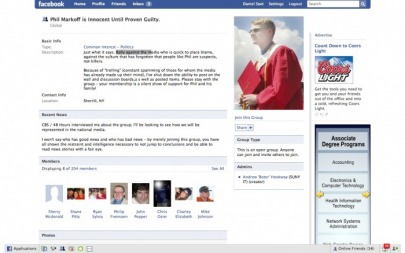
But countering this is a Facebook group called 'Phil Markoff is Innocent Until Proven Guilty' where its members (currently at 204, and growing!) are making a stand against what they describe as presumptuous media culture that has basically 'decided' that Markoff is guilty of the murder of Brisman, even though the case is still being deliberated.
I certainly applaud the efforts of the latter because it is yet another testimony of how far public discourse has come, especially with the transformative impact of the WWW and Web 2.0 technologies. What would've perhaps been a laborious paper-based petition (or remember those email-chain petitions where you just added your name and forwarded it to a friend hoping he/she would do the same and keep the chain going?) that still needed to be brought to the traditional media's attention to give it a more 'viral' potency, has now, because of the digital age, been taken online. In the same breath, lay people like you and I, and in this case, Phil Markoff's friends and sympathetic community, are empowered to do something to get the word out (it is useful to think of this as an outbound communication campaign).

No matter how this case pans out, it's definitely a live PR 2.0 exercise worth studying - especially how social media is being applied by the lay community to counter not to much the government's information campaign, but the media's perceived agenda-setting function.

Keep watching this space!



What kinds of products and services catches your attention when you're surfing the Internet?

Chances are, it's not going to be email offers, banners ads or pop-up ads but rather product information contained within articles that's going to translate into action.

At least, that's the conclusion of research performed by ARAnet with polling done by the Opinion Research Corporation (see 'Brand mentions preferred over Ads' by eMarketer).


Online articles that include information about brands stood out at 51% (selection by respondents), with email offers coming in at 47%. Sponsored search engine links stands at 39% while banner ads and pop-up ads stand at 25% and 13% respectively.

A key finding of the study is that younger audiences tend to respond more favorably towards product information that comes in the form of articles and write ups. Between 50-60% of those aged between 18-34 were either somewhat likely, or very likely, to take action after reading online articles with brand information.

Pop-up ads, on the other hand, ranked very poorly in terms of their call-to-action, with 87% of participants indicating that they were not like to respond to them.

You may be interested in the rest of the demographic data that is presented in the eMarketer article, but one thing that's clear from this report is the increasing importance of content or knowledge leadership as a form of strategic communication on the Internet today.

As I've argued previously, one's credibility as communication professionals will depend on how much people see them as knowledge or content leaders – whatever the organizations may be specializing in. Regardless of one's communication platform, the aim is to become a trusted and sought-after knowledge resource for the community (Solis and Breakenridge, 2009, p.18).

The ARAnet study goes some way to reinforce that, but therein also lies the paralleled danger of quick-thinking marketers who increasingly seek to disguise their ads as content.

If this becomes a mainstream practice (and I'm sure it will, given that economics and what sells will ultimately drive commercial practices), then the expected consequence and impact in due time is that people will switch off with content as well. This may well be a smoldering crisis in the making for the PR 2.0 industry to seriously contemplate today!

PR practitioners better start thinking of ways to counter this impending 'misinformation' propaganda soon, or there will be a day when even good and credible content will be bypassed along with the spam and informational flotsam!

Maybe this is why Mark Drapeau argues passionately against brands being on Twitter (see the Mashable article 'Do Brands Belong on Twitter?') because, apart from the argument about whether it is brands or people that are communicating on the platform, the long term effect is a cluttering of the statusphere as well as the desensitization of people's awareness between what constitutes brands and what constitutes genuine attempts by others to share information and content.

I don't have clear solutions right now, other than to sound this matter out. But I'd certainly be interested to know what you think.


Recently, Deirdre Breakenridge blogged about the state of affairs between PR and journalism because of the increasing influence of social media. Her fundamental conclusion is that the two practices will always share a symbiotic relationship despite the transformative impact of the communicative and networking capabilities wrought by Web 2.0 technologies. I couldn't agree more, and since she asked for readers to add their thoughts about the question, I offered the response below as I pondered this matter...


I think one of the answers to this question must lie in the philosophy about modern-day customer relations and the fact that, because of citizen journalism empowered through social media platforms, anybody can talk about anybody else and their comments may gain incredible traction and go viral online. With this in mind, organizational PR or public affairs practitioners can no longer just single out journalists as their main target audiences because even the ‘ordinary’ member of public calling in through the phone may well turn out to be the biggest fan, or critic, depending on how he/she was treated during the transaction.

So who's our A-List journalist, now that almost anyone with access to the Internet can and is probably maintaining a 'journal' or something of their experiences and opinions, with anything from a whimper to a roar of a following?

So, yes, PR/PA's relationship with journalists have fundamentally shifted and communication practitioners have a larger piece of the pie to look after. They need to be prepared for the fact that, unlike the generally greater immediacy of transactions with journalists that translates into 'effect' on the printed pages or the television screens, having a plan to foster good relationships with key bloggers and influencers may not lead to any discernible and immdiate returns, and returns are often not seen until a real relationship is forged (and God knows how long that will take).

However, not spending time and effort on blogger relations will almost certainly have negative consequences when crises hit. Social media means that everyone is a journalist, and for better or worse, organizations need to come to terms with this phenomenon.


But unlike the utopian situation where they can juggle perfectly with everything without dropping anything, the reality is that limitations in manpower and resources will mean that community engagement initiatives must be surgical and targeted. It's all about strategic communication planning.

The need to identify one's communication ecosystem and who the most influential communicators are, vis-a-vis how much the PR unit can competently do, will be inevitable. My view is that as much as communication practitioners need to keep their eyes opened and not discriminate anyone in the communication ecosystem, they have no choice but to plan carefully how they prioritize their outreach efforts. To aim to reach out to everyone is laudable but idealistic. They will need to be 'on target' with the key influencers so that it gives them a fighting chance of managing a flow and dialogue with the hope that additional layers of conversations can be added over time as their communication management system matures and stabilizes.

To do so simply helps to ensure survival.

Not to do so will be utterly suicidal!


At the recent Community Engagement Program (CEP) Seminar in Singapore (see Channel NewsAsia’sBloggers, moderators can help ease public fears in crises’), Home Affairs Minister Wong Kan Seng made the point that in times of crisis such as a terrorist attack, website moderators and bloggers have a role to play in helping to communicate a message of calm and normalcy, as well as to ease public concerns. He also made an important point about how these, together with collaborative efforts by the broadcast media and grassroots-based community engagement initiatives, must be a part of a unified online-offline campaign (what I call the communication matrix).


Indeed, there's no other time like the onslaught of a national crisis that requires a harmonized, authoritative and complementary stream of narratives with a message of order and control. Communication scholar Perl (1996) says that during a crisis, it’s especially vital to make a speedy rhetorical response in the first 60 to 120 minutes. Referred as the ‘golden hour’ in crisis management, the damage to image and reputation decreases with early and effective efforts at public communication.


But this is clearly predicated upon consistent messaging because of the need to coherently frame the situation. Framing, according to communication scholar Oscar Gandy, guides the processing of information so that a preferred reading of the facts comes to dominate public understanding (Jamieson & Waldman, 2003, pp. xiii-xiv). Given the challenges of citizen journalism and user generated content (UGC) today, governmental and organizational crisis communication needs a strategy that presents a consistent and coordinated messaging which builds the desired narrative concerning how the crisis is being managed.

Coming back to what Minister Wong said about the role of bloggers and website moderators during crises, realize that these are important relationships that must be forged not in the cauldron of an emergency but during periods of normalcy. Think about the blogger relation techniques discussed in the previous post, and consider how you can identify those influential bloggers that are in conversation spheres that are of interest to you and your organization. Developing a close relationship with them, even if you may not see much fruit in peacetime because it is a social capital stock whose dividends that's reaped when the crunch comes.

While we’re at this topic, here are some issues for you to think about:

-    What does your conversation ecosystem look like?
-    Where are your main spheres of conversations (are they mainly offline, or online, and where are they occurring)?
-    What kind of resources are you devoting to understand these nodes of conversations and how you can build closer bridges?
-    Given your inherent limitations, what are the ‘priority’ conversation spheres that must be tackled or engaged immediately.
-    Similarly, what can be pushed back in terms of priority?
-    Do you have a list of strategic issues that you want your communities to know about?

Think about it! I am too…


References
Perl, David. “Critical Success Factors for Effective Crisis Management.” Bernstein Crisis Management. 1996. Retrieved June 21, 2008, from http://www.bernsteincrisismanagement.com/nl/crisismgr050815.html

Jamieson, Kathleen H., and Waldman, Paul. “Introduction.” The Press Effect: Politicians, Journalists, and the Stories that Shape the Political World, New York: Oxford University Press, 2003, pp. xiii-xiv.


How does one go about setting up a combination of applications to cast a wide enough net across cyberspace to reel in the dynamic and ongoing buzz surrounding an organization?

Well, here's an outsider's perspective to this whole business of buzz monitoring...

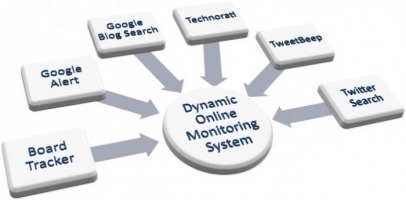
After sieving through the advice given by Lorna Li (Jan 2008), Breakenridge (Mar 2009, personal communication), Andy Beal (@andybeal) and others, I've come to a conclusion that the common thread of advice among the practitioners is that to have a dynamic online monitoring system, one needs a combination of both active and passive search systems to effect a comprehensive sweep of the Web.

It really helps that many of these tools today have built-in features that allow breaking information to be channeled directly to our preferred RSS reader or straight into our designated email account. There are also features that increase the frequency of the reports from daily to hourly bulletins – which may them excellent platforms during crisis communication management when there needs to be a close scrutiny of the chatter on the web during the first few hours of a crisis situation.

Active Search Systems
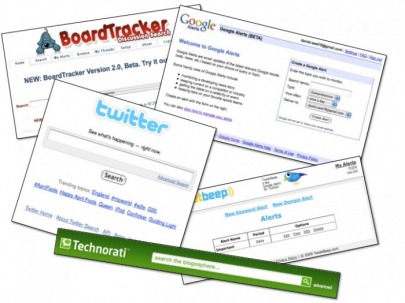
BoardTracker, Google Alert and TweetBeep are examples of active search applications whereby subscribers will  be automatically notified (either through email or RSS) about the latest search results pertaining to our query or topic of choice. With BoardTracker covering forum threads, Google Alert covering updates that appear in news, blogs, web pages updates, video and groups, and TweetBeep covering updates on Twitter, users of all three applications can be assured of a fairly comprehensive search of the Web across the most common social networking and UGC (User Generated Content) platforms.

Passive Search Systems
However, whereas the three applications listed above are acting as live sonar systems constantly ‘pinging’ away in the sea of information for keywords that match the rules we’ve set, there also a need to use other more manual systems like Twitter Search, Google Blog Search and Technorati (the latter two cover the blogosphere), which offers depth and historical span of research.

The six applications covered here are just some of the many platforms that practitioners may use in their buzz monitoring operations. The key principle is to always utilize a mashup of live systems at the front-end, backed up by additional tools that allow in-depth search when called for.

Most, if not all, of these have a free basic service that we can subscribe to and use at the cost of our time and effort. We'd be insane not to tap on such capabilities!


Building on from the previous post, after identifying where the main spheres of conversations are relative to the organization, it’s time to step in, listen, and participate. However, one can’t just enter a community out of nowhere and expect to be able to engage people in dialogue.

In this regard, Lorna Li (Aug 2008) uses the term ‘ingratiating oneself,’ while Steve Wilson, senior director of global web communication for McDonald’s Corp - quoted by David Meerman Scott in The New Rules of Marketing and PR, (2007, p.58) - says, “If it [the organization] is going to get credibility and trust, it is necessary to participate in the… community, [but] we can’t just jump into the… [conversational] storm without having built a dialog first.

I cannot agree more. As so many PR 2.0 practitioners have said, the new PR puts the emphasis right back on relationship-building, and relationships, like Rome, just aren't built overnight!

Four-Step Strategy to get Engaged
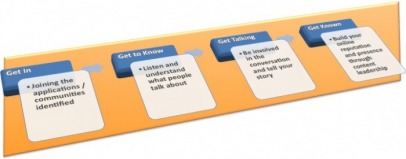
In order for organizational ambassadors to be tactically engaged in some of the pre-identified online communities in ongoing dialogues and relationship building (what social networking is all about), I would propose the following
four-pronged approach:

Step 1 - Get In
The four-step model starts off with the identification or the singling out of key communities and influencer groups according to the nature, frequency and location of the conversations. Once these have been identified, it's time to join those applications and communities.

Step 2 - Get to KnowEven after joining a network, it’s easy to want to jump in and start the chatter. It’s probably fine if this is a personal account because the worst that can happen is that you lose a couple of followers. More caution is obviously required if you're doing it as a brand because you stand to discredit yourself as an organization by speaking too hastily.  This is similar to a piece of advice I got while attending a public affairs lecture at a public entity recently. There, the speaker said that when handling media interviews, he tends to hold out and listen to all the questions the reporter is asking, even when he thinks he knows the answer to some of them. This practice helps him to better understand the thought process of the reporter and avoid what could be potential loaded questions.

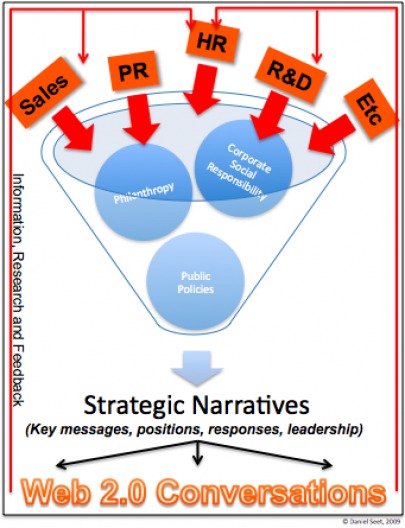
In the same spirit, the ‘Get to Know’ phase of the engagement strategy is really like a focus group in action where you watch the conversations that are going on, feel the pulse of the community and where they stand on particular issues, and channel valuable market research and feedback to relevant departments of the firm to help them develop better services and policies. Think back in terms of the funnel model and how market feedback is used to shape and refine the very strategic narratives and other organizational products and services that are provided to the
community.

Hence, get to know what other people are talking about.

Step 3 - Get Talking

PR 2.0 practitioners will tell us that we should start of our participation on the social media communities NOT by creating content on our own platforms (though there’s nothing to stop us from doing so) but by looking for areas of conversation within those communities – identified through the previous phase – where we can leave our thoughts and comments.
Chris Brogan (Nov 2008), President of New Marketing Labs, says that to grow our presence in the community (and also build an interested following), we need to go to other people’s blogs [and social media platforms] and start getting involved. This is predicated upon knowing what others are saying and where they’re commenting. And the more we make our voice heard in the space where we want to do business, the better we’ll be.

In a similar vein, Breakenridge (Mar 2009) suggests that we ought to be maintaining a list of our favorite bloggers whom we read and comment regularly, and we also need to be sharing interesting posts and other news/information with members or our social networking communities.

It’s actually all about being a useful member of the community instead of trying to market our ideas to them from the get go.

Step 4 - Get KnownThe final phase of the four-step strategy deals with building the brand’s online presence and reputation. I believe this would depend on how much people see us as knowledge or content leaders – whatever our organizations may be. In some organizations, that could be chemical or environmental safety, and in others, it could be tips to build your own greenhouse, for example.

There is no silver bullet to this, and reputation building both online and offline require much time and effort invested into cultivating the right image and perceptions. Think of this as a continuation of the good work from Step 3. Ultimately, it's still a matter of developing credibility via content leadership. The aim, as Solis and Breakenridge (Putting the Public back in Public Relations, 2009, p. 18) put it, is to become a trusted and sought-after knowledge resource for the community.

But apart from just pushing out our own organizational information, we actually need to take full advantage of the constitution of the Web and generate rich media links online. Levick and Smith (
STOP THE PRESSES: The Crisis and Litigation PR Desk Reference, 2007, p. 97) say we need to connect the dots by gathering information and links from a variety of [reputable] sources, keep the information current and spread “information packages” with blog excerpts and supportive hyperlinks.

Secondly, build up on the area of blogger relations and develop your own A and B lists of influential bloggers. Get to know them. Understand their worldviews and how they perceive issues. Develop relationships that may eventually transcend into guest-blogging for them, or having them guest-blog for the organization (third-party ink).

However, we must note that developing all the positive relationships with bloggers in the world, though essential, cannot replace thoughtful, genuine and disambiguated content to create chatter on the Web. Good, honest content will influence bloggers to talk about it, which will eventually lead to buzz and traction for the organization and its products on and offline. It’s the age of curiosity or affinity marketing – as blogger and communication practitioner Carrie Wilkerson (@barefoot_exec) puts it during a recent online webinar organized by the Social Media Bootcamp (SMB) by Joel Comm (@joelcomm).

Instead of selling something directly, a great website, a great blog or podcast, an ebook, or the content on your Facebook and Twitter pages [i.e. your overall presence on the Web], actually tell the world indirectly that you or your organization is smart, that you understand the market well, and that you’d be a valuable and trustworthy person to do business with because of the leadership in the marketplace of ideas (Scott, 2007, p.38).


The model shown above is designed to illustrate the concept of a proposed system for delivering this ‘list’ of strategic narratives (i.e. key messages, positions or responses) to inform your social media engagement planning function.

The rhetorical and narrative planning is essential because unlike personal communication and participation on social media, where the most you stand to lose are your followers, the consequences are more severe for the organization because it loses ground in terms of public mindshare and credibility.

The model can be divided into four key components:

(1) Collating a list of issues, practices, plans and activities of individual departments that may be of interest to the public.

(2) Putting the list through a sieve - to be worked out internally - to flesh out a shortlist of items that best represent the core principles or positions, and then making this list known the the social media ambassadors. The issues may also pertain to information that can place your company in a position of knowledge leadership in the community/industry.

(3) Continuous environmental monitoring, and forwarding of information, research data and feedback to the various departments to inform their respective decision making processes.

(4) Ongoing review and refreshing of of the list of narratives (weekly, monthly, and in response to sudden contingencies).


Why plan? Here are some things to consider:

How often you're going to publish content. Is it weekly? Fortnightly? Monthly? You've to make sure it's frequent enough to give people a reason to come back to your blog or site. (at least one post a week is a minimum, I'd say...)

The next thing to consider is where your content will come from. Are you going to generate it all by yourself? How about getting other departments to chip in stuff that the public may find interesting or relevant? Stuff that helps them save money would help, for example... or information that tells them the best way to take care of a product your company sells...

Do you have enough to last the distance? Remember that engaging the public with your content isn't a flash in the pan. You'll need to have, depending on your prescribed publication frequency, thought about what you'll be publishing at least three months in advance, and build up from there.

Otherwise, you'll probably find yourself hitting rock bottom in terms of content because, let's face it, some  days we do run out of ideas.

Bottom line, and this may be cliched but its true: If you fail to plan, you plan to fail.


I'm now in the midst of refining the first draft of the social media roadmap template that I first blogged about on 28 Mar 2009, and I thought it'll be interesting to keep you updated on what's transpiring so far. So here's an excerpt from my current work...

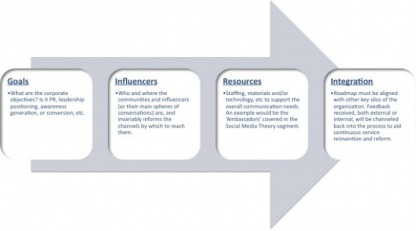
When planning its communication roadmap and making their initial strides towards social media competency, organizations must keep in mind the 4 factors of Goals, Influencers, Resources and Integration (adapted from Li, 2007; Breakenridge, 2009, personal communication).

In a sense, think of this as part of strategic communication planning that entails a very careful internal and eternal stakeholder/influencer analysis before charting out the rest of the plan. Remember that gaining traction with your communities and their conversations require more than just getting on board various social media applications, and strategic planning at this juncture will be a critical part of communication success!

Refer to the graphic below (click here for enlarged version on Scribd) for an illustration:


Seeing Things in Perspective
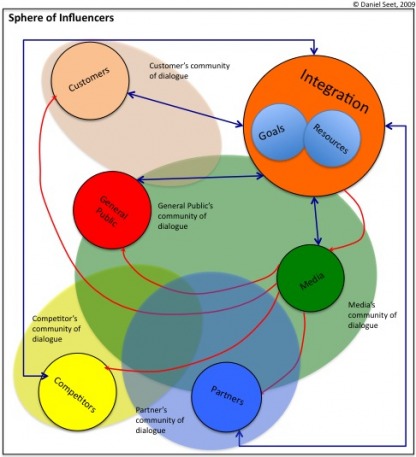
The next illustration below places the four factors of Goals, Influencers, Resources and Integration into perspective. Using the orange node to represent the organization you belong to, think of the critical elements of integration goals and resources as subsets of the organizational system due to their inherent functions as part of its internal processes and systems. The influencers are in the wider environment that the organization exists in (so in a sense, this has a hint of the
Social Media Ecosystem by Deb Schultz).

Red lines map the conventional approach of getting messages heard – i.e. via the media, which then retells the message via news stories to other ‘groups’ like the customers, lay public, partners, etc. But notice that each ‘targeted’ group actually has its own sphere or community of dialogue where their conversations occur (some which overlap with that of other groups). The aim then, is for us as communication professionals to understand where these ‘other’ conversations are going on, and then build a direct connection to support direct ‘1-to-1’ dialogue (as Brian Solis puts it) as represented by the blue double-arrowhead lines.

This is still a work in progress for me, so please feel free to tell me if this model is useful in helping you to understand the communication matrix of new and 'old' media that we now have to manage.


It's certainly been a while since I last posted something.

Truly sorry about it!

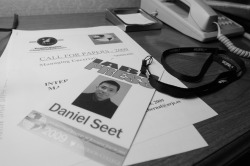
A few colleagues and I were attending the International Academy of Business Discipline (IABD) conference held in St Louis, Missouri between 2 Apr and 5 Apr in the dual role of the event's publicity team (fueled totally on Emerson student power, I must say!!!) and also to make our own individual presentations.

Hosted at the Hilton St. Louis at the Ballpark, this edition of the IABD drew some 135 participants from colleges and universities in the States.  There was also a sizeable international crowd as well (Iran, Portugal, Spain, and the U.K., just to name a few).


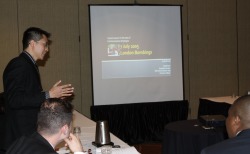
As you can see from above, I was also here to make a presentation the communication strategies and lessons learnt from the 7th July bombings in London (click here to view the powerpoint slides).

But for me, this whole trip has been a learning experience on a grand scheme of things, especially on the social media front! Look out for my subsequent blogs where I'll discuss some social media elements from my paper, as well as some nuggets I mined from a panel discussing Web 2.0 technologies.

Now back to this…

Since I’m the owner of a fairly new Cannon Rebel DSLR, I was voted as the official cameraman in my team of five (I've embedded the photofeed from Flickr just to give you a flavor of the event).

In addition to that, all of us were also running around with Flip Video camcorders (made by Pure Digital Technologies, a company bought by Cisco Systems in March of 2009 – click here to read the background) and digital voice recorders.

Accounts on multimedia photo and video platforms like Flickr, Youtube were created, and we were all given authorship access to it. This was strategic because it gave everyone on the team plenty of mobility, not to mention scalability and responsiveness to the dynamic situations on the ground.

Basically what happened for us was that we were frantically going around from breakout session to breakout session to either record a snippet of the discussions, or find someone to interview (as I recall, we often did both). And then we had to grab hold of the lull time in between sessions to upload our content.

It was, for me, a new experience in the world of User Generated Content (UGC) since I had never really got my hands dirty doing vlogs (video logs) or podcasts.

Apart from that, this was also the first time that we were using Twitter to add some jazz and buzz to the events – at least as far as we could – through regular updates throughout the day. I remember trying to upload fresh photos on Flickr in between catching a quick breather at the hotel lobby (where WIFI access is free)…

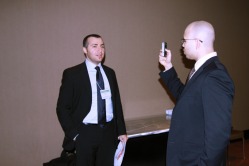
In the picture below, for example, one of my colleagues was in the midst of uploading fresh tweets after the speaker (foreground) had made an interesting point.


Observations and Some Lessons Learnt
First and foremost, I think the overall concept of operation has been a sound one – and one that also makes it easy for any in-house PR team to adopt.

Using a blog platform - check out the IABD Press blog that was created for this event - as the flagship site to talk about the event was a great idea because it makes it easy to manipulate with little need for HTML knowledge (though that would be an obvious plus).

It also allowed us to integrate other freeware applications like Flickr and Youtube to jazz up the interactivity of the entire content and presentation.

I was in fact really thrilled each time I had a fresh batch of photos to upload. I suppose it’s the thrill of being able to see the content you’ve just produced put into its proper paces with little fuss but maximum impact.

Basically what happened for us was that we were frantically going around from breakout session to breakout session to either record a snippet of the discussions, or find someone to interview (as I recall, we often did both). And then we had to grab hold of the lull time in between sessions to upload our content.

It was, for me, a new experience in the world of User Generated Content (UGC) since I had never really got my hands dirty doing vlogs (video logs) or podcasts.

Apart from that, this was also the first time that we were using Twitter to add some jazz and buzz to the events – at least as far as we could – through regular updates throughout the day. I remember trying to upload fresh photos on Flickr in between catching a quick breather at the hotel lobby (where WIFI access is free)…


But what about areas that we could’ve done better?

I would have to say that the Twitter experience wasn’t as effective because we launched it too late.

But to be honest, Tweeting was really an afterthought and more of a fun suggestion. Still, for the benefit of future student cohorts that’ll take over the baton for the subsequent IABD coverage, it’s important to market our platforms way in advance if we're to create awareness, retention and finally, participation.

This year it was really late that a Twitter account for the press team was established, but I won’t regret the move because what we are handling down to the next team is a better-integrated communication and publicity platform (not to mention systems) indeed.

I suppose that due to the size of the group, and the fact that we are also presenting papers during the conference, we were sort of stretched thin most of the time.

One of the issues I felt was that our written content on the blog wasn't as frequently updated as it ought to... though I thought we did exceptionally well in creating a whole library of photo and video testimonies!

Just perhaps... had we been able to include other elements like podcasts and even upload powerpoint presentations on our IABD Press blog or even the official website, it would've made the channel such a value-adding proposition for visitors.

In fact, I’m also looking forward to the day when participants will be actively contributing their own blogs, comments and experiences to our blog forum.  This will be a step up as it adds a fresh and evolving layer of contextual and experiential details that will be such a priceless knowledge hub as time rolls on.

It is perhaps also the next level of dialogue that we need to aspire towards.

Still, it has been a great experience, and one that once again reinforces in me the conviction that integrated new media is the way to go in the future.

The next stage for the IABD Press is perhaps to consider developing a Facebook account as well as a LinkedIn profile. PR 2.0 and other new media practitioners understand that because today's market is very fragmented, communication needs to be taken to as many spheres as possible so that a presence may be developed - and conversations may begin.

So perhaps, it is ironic but true that as much as new media and Web 2.0 technologies makes it easier for us to connect with others, real communication is largely a very manual and laborious process of getting involved personally in the communities and groups out there.

This and several aspects of Web 2.0 developments will be covered in my next blog, so look out for it...

Till then!


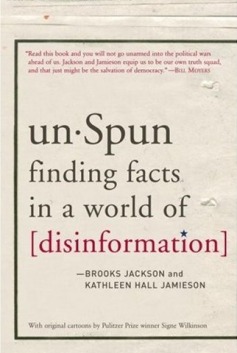
I’d like to think that when Brooks Jackson and Kathleen Hall Jamieson published their book un.Spun: Finding facts in a world of [disinformation] in 2007, much of the cyberspace-connected world (I've to make this distinction because I've friends who vehemently point out that not everywhere is like the U.S., so there… I said it!) was just awakening to the intriguing potential of Web 2.0 communication and socialized media.  

But in a sense, their scholarship came at an opportune time when talk about the new paradigm and attitude to communication in PR 2.0 was also gaining momentum.

How does the two reconcile, you may ask?

Jackson and Jamieson primarily deal with the cornerstone theme of fact-finding in the ocean of information, and how people ought to protect themselves from the predominance of spin and misinformation in the midst of consuming today’s media.  As they put it, people must be taught how to fend for themselves exactly because they are daily being exposed to such an enormous volume of deception that goes unchallenged by government regulators, the courts or the news media (2007, pp. 21-23).

That is well and true, but before we get to the how, I thought it’ll be interesting to do a quick expose on the human psyche.


The Human Conundrum
I really like the point they make that people aren't hard-wired to be fact-driven. On the contrary, irrationality tends to rule. The authors (2007, pp. 19-21) quote psychology tests that demonstrate how we tend to, when receiving information, seek out even weak evidence just to support their base beliefs, ignore or play down other evidence that undercuts those beliefs, and even go to the extent of applying stringent tests on conflicting evidence with the hope of debunking them, while at the same time failing to critically evaluate the truthfulness of the side of the argument that they have adopted.

We all have a mental desire for certainty (perhaps this harks back to Maslow’s Hierarchy of Needs where certainty is linked to a feeling of security? – my posit only), and share in the dislike of having to agonize over whether a right decision was made. Jackson and Jamieson (2007, pp. 79-81) argue that although this may help us avoid being frozen by indecision, it can also cause us to be ‘locked in’ on a particular mindset that’s hard to reverse even after new facts emerge.

Think WMDs in Iraq, which was one of the basis of the American invasion of the country. Then think about the gradual turn of the narrative tide when none was found, but the occupation continued.

Alright, maybe this is too political an example, with too many other nuanced factors to be considered. Try this then...

Think about a phonecall to your local bank, where, after negotiating a maze of buttons to finally get to the operator, you’re put on hold because of high call volume. A minute passes, and you wait. Then two, and five and soon, its 10 minutes, and you’re still waiting and getting that notoriously despised ‘your call is important to us’ message. After a certain threshold (mine’s 15 minutes tops!) we seem to enter a zone where we agonize at having waited for so long, but feel reluctant to hang up because of the notion of hope that somebody will come on line the next second.

I should know, since I went through this drill yesterday. I just hung up after 10 minutes.

Back to this…

It proves the point that people manage most of the time on an ‘autopilot’ mode, and use mental shortcuts (or heuristics) so as to avoid having to think everything through constantly. And while the authors agree that cruising on autopilot is useful in helping people deal with the mundane and minutiae in life, it helps to switch on the thinking cap when it comes to making bigger decisions.

In short, we’re challenged to always consider the arguments presented, and counterarguments to be had.

But going back to the initial operating environment described by Jackson and Jamieson, just how do we manage our information when there’s so much misinformation?


The Socialized Cyberspace Sieve
This is where the Internet comes in. If used carefully, it’s actually a very powerful solution to the spin we find in today's world because it gives people so much more direct access to knowledge and information that at any other point in time (Jackson and Jamieson, 2007, (pp. 127-128).

Of course, we do have to be cautious with the things we see online because anybody can say anything they want on it; they may also make their postings anonymously, or through an avatar, or even under an assumed identity.

But where there is uncertainty individually, there is strength collectively! And this is where the power of the socialized media should be tapped for fact-finding purposes.

Social media and Web 2.0 are altering the entire media landscape, placing the power of influence in the hands of regular people with expertise, opinions, and the drive and passion to share those opinion,” say PR 2.0 evangelists Brian Solis and Deirdre Breakenridge (2009, p.1).

The socialized web is empowering a new class of authoritative voices and these are people just like you and me.

It’s the power of a community of contextualized knowledge – a massive network of almost self-policing information put in the right place and setting.

In his most recent blog on 30 Mar 2009, Solis said, “Socialized media is empowering us to not only consume content, but also create it. This is the era of new influencers and we become media and earn authority based on the content we share and also how and where we participate.

Take the news for example.

I was doing a piece of public affairs research just two months back about the U.S. media coverage on the ongoing violence in Mexico due to the drug situation, and was looking at the ABC story by Avila, Tribolet and Mucha on 28 Dec 2009 in particular.

That news piece was, in my opinion, certainly not one that measured up to the highest of journalistic standards because it was outdated, over generalized and intended to mislead (click here to read more about that media analysis project).

But being a story covered on a prominent broadcast media, was there any hint of people getting grossly led on the wrong track?

Surprisingly, not at all.

The ABC story generated a list of 25 comments from readers, and a quick review of the postings reveal that they are not misled by one sided or inaccurate reporting. In fact, many of the ‘netizens’ who commented on the ABC story highlighted their unhappiness over the an old story, and its overgeneralization about the troubles in the Baja region.  

There’re also posts by readers who highlight the point that much of the violence in Mexico is actually being fuelled by the demand for drugs in North America. This and the flow of U.S. guns and money into the hands of the cartels have all but been proven to be absolutely true in the recent media coverage of Secretary of State Hillary Clinton’s visit to Mexico.

The power of collective contextualized knowledge that gives expert power to the ordinary folks.

Jackson and Jamieson (2007, p. 159) echo the same point when they suggest as a rule that when doing fact-checking, one should always verify if the claim is being backed up by an expert panel. Triangulate the information, they say. Agreement by a community of experts is usually indicative of the credibility of the information, and while consensus isn't proof, we can nevertheless be much more confident that we’re starting on the right footing if we use information that’s accepted by authorities on all sides.

In today’s world of socialized media, that means all of us are experts with the power to get involved (I’d say, why not try a Twitter Search factcheck on a topic of choice to have a taste of what people are talking about?).


What does this mean for Communication Practitioners?
For one thing, the same lessons that un.Spun provides for normal consumers of media and information to watch out for are also the very communication pitfalls that we as practitioners must avoid. I think this aspect is clear enough so I will not elaborate on it.

But coming back to this focus on Web 2.0 and the socialized media, I'd argue that our credibility as communication professionals will depend on how much people see us as knowledge or content leaders – whatever our organizations may be.

Regardless of our communication platform, our aim is to become a trusted and sought-after knowledge resource for the community (Solis and Breakenridge, 2009, p.18).

Apart from building our own presence on the Web by listening in on ongoing conversations in the WWW, and by participating in dialogues on social media platforms, blogger relations is also another area worth looking into as we seek to build content leadership and help the organization gain an aura of legitimacy (David Meerman Scott, 2007, pp. 16-17).

Instead of focusing efforts on a potential PR blockbuster success, say [a one-off] appearance on the Oprah Show, it may well be more effective to have hundreds of bloggers reviewing the same product and service, and then virally communicating this across the web to reach potentially countless readers and customers,” Scott (2007, p.24) continues with his point.

But this isn’t so much about getting in touch with the bloggers as it is about developing thoughtful, genuine and disambiguated content to create chatter on the Web.

Good, honest content would influence bloggers to talk about it, which would lead to buzz and traction for the company and its products on and offline.  It’s the age of curiosity or affinity marketing – as blogger and communication practitioner Carrie Wilkerson puts it during a recent online webinar organized by the Social Media Bootcamp (SMB) by Joel Comm.

Instead of selling something directly, a great website, a great blog or podcast, or an ebook [i.e. your overall presence on the Web], is actually telling the world indirectly that you’re smart, and that you understand the market very well, and that you’d be a valuable and trustworthy person to do business with because of the leadership in the marketplace of ideas (Scott, 2007, p.38).


Conclusion
While Jackson and Jamieson’s book offers largely timeless tips about rising above the cacophony of noise or disinformation, I felt I just had to run with their point about how the Internet can be a great resource, and point to how social media can actually provide people with more channels and avenues to verify not just the factual validity but also the contextual validity of claims they’re trying to investigate.  

Web 2.0 is a tremendous resource for aggregated truth and knowledge, and this is also forcing organizations to rethink their traditional marketing approaches and move into knowledge production and content leadership as a means of getting their thoughts above the dross and informational flotsam [read SPAM].

I'm anticipating that this will create a new dynamic in the information economy: a web-savvy and healthily skeptical community meeting with a new corporate conscience dedicated to leadership in great and meaningful content.

It may be un.Spun coming to life in a brand new light!